Babylon and Mystery Babylon in Bible Prophecy
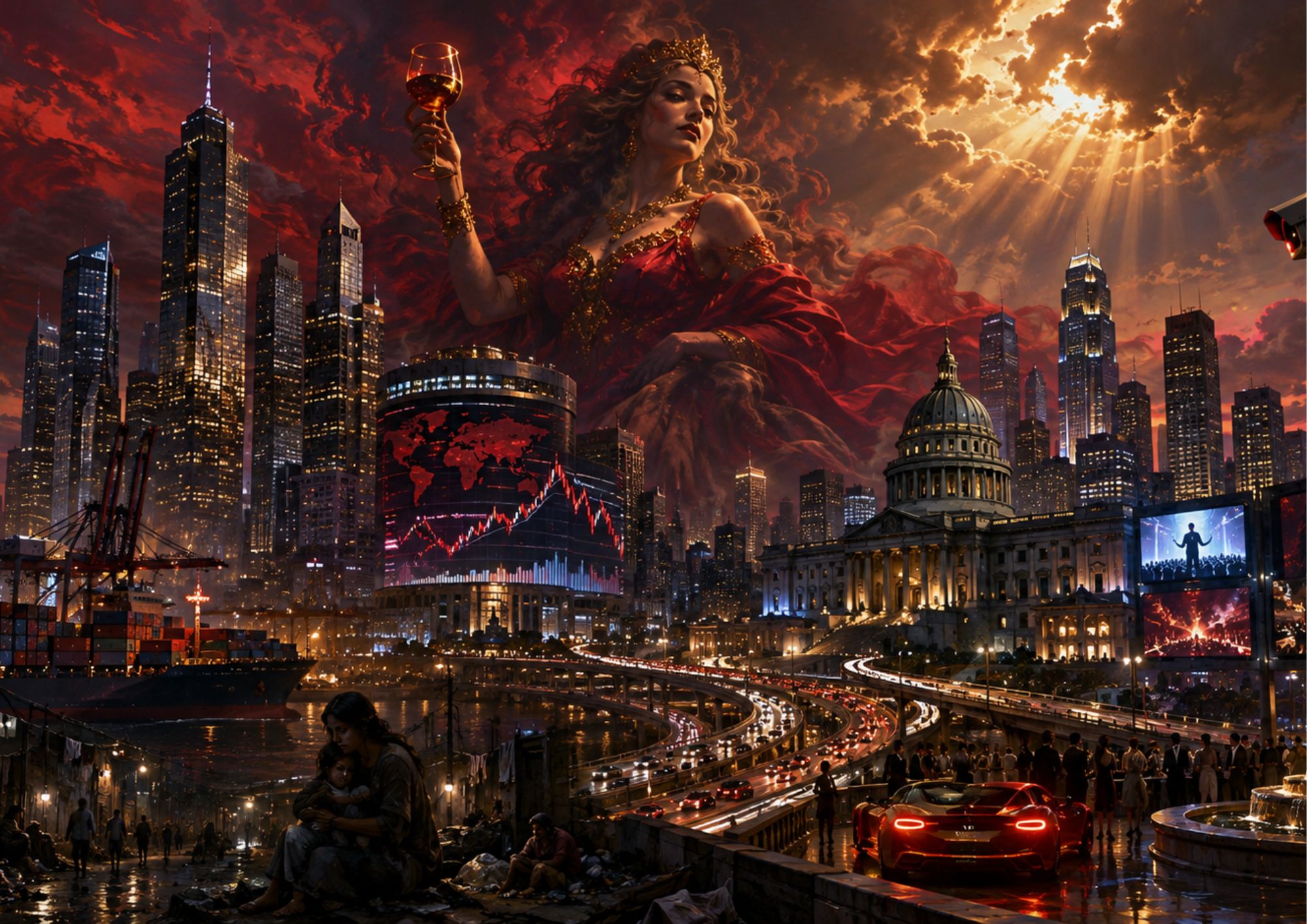
The subject of Babylon appears repeatedly on ChristianIdentityChurch.wordpress.com particularly in material dealing with Revelation 17 and 18, Jeremiah 50 and 51, the world economic system, political power, organized religion, and the position of the United States in Bible prophecy. Taken together, the material on the site presents Babylon not merely as the ancient city that once existed in Mesopotamia, but as a prophetic system that operates among the nations in the latter days.
There are differences of emphasis among the writers represented on the site. Pastor Sheldon Emry’s lengthy study, What Is Mystery Babylon?, describes Mystery Babylon primarily as a worldwide political and economic system. Richard Hoskins describes Babylon as an interconnected structure involving international commerce, government and organized religion. Wesley Swift emphasizes its false religious or ecclesiastical character. Other material on the website explicitly argues that the United States, with New York City playing a central role, fulfills the prophetic description of latter-day Babylon. The site’s own editorial note on one of these articles distinguishes between America as New Jerusalem and the Babylonian system operating within or over America.
Mystery Babylon Is More Than Ancient Babylon
In What Is Mystery Babylon?, Pastor Sheldon Emry begins with the woman described in Revelation 17. He interprets her as an anti-Christian, world-ruling system that exercises control over nations. He connects Revelation 17 with Revelation 18 and argues that the prophecy concerns a power that would affect governments, commerce and the lives of Christians throughout the world.
The study also argues that Jeremiah 50 and 51 should be read alongside Revelation 17 and 18. Emry maintains that Jeremiah’s description cannot be limited to the historical Babylon of antiquity because Jeremiah speaks of a Babylon whose influence reaches the nations of the earth. He draws a parallel between Jeremiah 51:7, where the nations are described as drinking Babylon’s wine, and Revelation 18:3, where all nations are likewise said to have drunk of Babylon’s fornication.
According to this interpretation, Jeremiah and Revelation are speaking prophetically about the same general world power. Ancient Babylon becomes a type or pattern for a later Babylon whose influence is international. Emry calls the latter system one of debt, money, war, plunder and oppression.
A Political, Economic and Social System
Another article on the site, Healing a Sick America, gives a concise definition. It says that “Mystery Babylon” is used as a blanket term for political, economic and social evils operating together as a massive world system.
This interpretation makes Babylon much larger than any individual church, government or corporation. The various institutions are regarded as parts of a larger structure.
The economic side receives particularly strong emphasis. Emry states that Mystery Babylon is “more economic than religious” and bases this conclusion on Revelation’s repeated references to kings and merchants. He interprets Revelation 17:18 and Revelation 18:3, 15 and 19 as descriptions of a worldwide system of money and trade control.
The same theme appears in Healing a Sick America, where economic troubles and manipulation of money are placed within the framework of Mystery Babylon.
Thus, according to these materials, one of the principal identifying characteristics of prophetic Babylon is control through economics. Money, debt, banking, interest, international commerce and the concentration of economic power are repeatedly placed within the Babylonian system.
The Merchants, Kings and Priests of Babylon
Richard Hoskins’ PDF, Babylon, presents the system in a somewhat different but complementary form. Hoskins traces the symbolism back to Babel and Nimrod and associates Babylon with centralized organization and world integration.
He then divides modern Babylon into three major ruling elements: the merchant, representing great international business; the king and his army, representing governments and their military power; and the priest, representing organized religion. Beneath these structures is the worker whose labor supports the entire arrangement.
The merchant occupies a particularly important place in Hoskins’ interpretation. He connects this directly with Revelation 18 and its description of the “merchants” of the earth. International banking, manufacturing, transportation, corporate agriculture, communications and media are all treated as extensions of the same commercial structure.
Hoskins also places the modern monetary and banking system within Babylon. His study associates lending at interest, international finance and centralized control over commerce with the Babylonian economic order. From his perspective, Babylon grows as independent businesses and local economies are absorbed into larger international structures.
Government is the second great component. Hoskins argues that political rulers protect the economic system and that military and legal institutions preserve its power. Organized religion becomes the third component when churches accommodate themselves to the prevailing political and economic order instead of teaching what the writer regards as God’s law.
In this interpretation, therefore, Babylon is not simply government, banking or organized religion. It is the union of these powers into a system that exercises increasing control over ordinary people.
The Religious Side of Mystery Babylon
Other material on Christian Identity Church places much greater emphasis on the religious aspect.
A sermon by Wesley Swift, The False Church Speaks Satan’s Lies, interprets the woman of Revelation 17 as a false ecclesiastical structure. In this presentation, Mystery Babylon represents apostate religion—an outwardly religious organization or network that claims spiritual authority while teaching doctrines regarded by the sermon as contrary to God.
This does not necessarily contradict Emry’s interpretation within the site’s larger framework. Emry acknowledges a religious part of Babylon but argues that the entire system cannot be reduced to one denomination or church. His 81-page study specifically rejects the idea that simply leaving one denomination and joining another constitutes “coming out of Babylon.” He argues instead that Babylon operates through economics, politics and religion simultaneously.
The site therefore presents organized false religion as one arm of Babylon rather than, in every article, the whole of Babylon.
Is the Roman Catholic Church Mystery Babylon?
The materials reviewed on the site generally reject the common interpretation that the Roman Catholic Church alone is Mystery Babylon.
Emry discusses this interpretation directly. He acknowledges that some interpreters identify the scarlet woman with Rome because of Revelation’s reference to seven mountains or hills, but he argues that this interpretation does not adequately account for the extensive economic and political descriptions found in Revelation 17 and 18. His conclusion is that Babylon is a much larger world system.
The article America and Mystery Babylon is even more explicit in rejecting the identification of Babylon solely with the Vatican. Its writer contends that the descriptions in Isaiah, Jeremiah and Revelation point instead toward the United States and its chief commercial city.
Is America Mystery Babylon?
This is where the site’s material becomes especially important, because two closely related interpretations appear.
In Emry’s What Is Mystery Babylon?, the United States is not simply equated with Babylon. Emry instead identifies North America, and particularly the United States, with Zion or the New Jerusalem while describing Mystery Babylon as a worldwide system presently exercising control over nations, including America. In his interpretation, America is under Babylonian influence and control but is ultimately to be delivered from that system.
The site’s own introductory note to America and Mystery Babylon expresses something similar. It says that America is the New Jerusalem in Bible prophecy while Mystery Babylon is part of “the System,” which the note associates with what is commonly called the “Deep State.” It anticipates the destruction of modern Babylon and the emergence of America/New Jerusalem afterward.
However, the article reproduced immediately beneath that note, written by Sherry Shriner, goes further and directly identifies the United States as the latter-day Babylon. It presents a long list of prophetic characteristics from Isaiah, Jeremiah and Revelation that it argues correspond to America. These include great military strength, international political influence, immense wealth, agriculture, industry, imports and exports, commerce, transportation, shipping, large cities and influence over the world economy.
The article gives particular attention to New York City. It associates Revelation’s “great city” with New York because of its international commerce, financial importance, seaport and the presence of the United Nations. The writer argues that in some prophetic passages “Babylon” refers to the country as a whole and in others to its principal city.
The Babylon category on the site also includes a 2024 item titled Washington D.C. is in Babylon, presented under the heading “The Nation’s Capital is Babylon the Great,” showing that the site’s more recent material continues to connect the Babylon prophecy with American governmental power.
Therefore, the website contains both formulations: America as a nation ruled or infiltrated by Mystery Babylon, and America itself as the principal latter-day national manifestation of Babylon.
Babylon and the Present World Order
Across these materials, Babylon is repeatedly connected with internationalism and centralized world power.
Emry’s study describes Mystery Babylon as already present rather than exclusively future. He portrays it as a hidden or poorly understood world-ruling system influencing national governments. The United Nations is identified as one instrument through which this international control operates, though not necessarily as the entirety of Babylon.
Hoskins likewise calls Babylon an international system and uses terms such as “New World Order” and “International Trade Cartel” while maintaining that none of these terms by itself completely describes Babylon. For him, its defining feature is the merging of economic, political and religious power into an integrated international structure.
The word “Mystery” is significant in this interpretation because the system’s true structure and control are said to remain hidden from most people. Emry concludes his study by saying that political, religious and economic mechanisms can exercise extensive control while ordinary people remain unaware of who is responsible or how the system functions. He regards this hidden nature as one reason Revelation calls it “Mystery.”
“Come Out of Her, My People”
The call of Revelation 18:4—“Come out of her, my people”—is central to the site’s interpretation.
Emry connects this directly with Jeremiah 51, where God’s people are told to flee Babylon. He does not interpret “coming out” simply as physically leaving a particular country or transferring membership from one church to another. He interprets it as refusing participation in Babylon’s violations of God’s laws. (Christian Identity Church)
Consequently, the site’s teaching connects deliverance from Babylon with a return to biblical law and separation from the economic, political and religious practices it regards as contrary to Scripture.
The Fall of Babylon
The final theme is Babylon’s destruction.
According to Emry’s reading, Revelation 17 and 18 describe Babylon at the time of its judgment rather than merely explaining how it originally came to power. Revelation 18’s language of sudden destruction is therefore understood as the final collapse of an already existing world system.
Jeremiah 51 is interpreted in the same manner. Babylon’s fall is linked with God’s judgment and the liberation of God’s people from the system of debt, oppression, war and false religion.
Emry’s conclusion is that Mystery Babylon’s spiritual, political and economic structure will eventually collapse and be replaced by God’s Kingdom.
Taken together, the material on Christian Identity Church portrays Mystery Babylon as an end-time system of international political, economic and religious control. Its most consistent characteristics are centralized power, international commerce, banking and debt, political influence over nations, religious apostasy and opposition to God’s laws. Some material identifies America—particularly New York and, in other places, Washington—as the principal modern expression of Babylon, while other material distinguishes America as Zion/New Jerusalem from the Babylonian system that presently exercises power within and over it. In either formulation, the site’s central expectation remains the same: the present Babylonian order will eventually be judged and destroyed, God’s people are commanded to come out of participation in it, and its fall will precede the establishment or restoration of God’s Kingdom.
Summary
From the material on ChristianIdentityChurch.wordpress.com, Babylon or Mystery Babylon is presented primarily as a system rather than simply one ancient city, one nation, one church, or one organization.
The different writers on the site do not agree on every detail. Some identify America itself as latter-day Babylon, particularly emphasizing New York as the commercial center and Washington, D.C. as the governmental center. Others, especially Sheldon Emry, make a distinction between America and Babylon, arguing that America is Zion or New Jerusalem but has come under the control of a Babylonian system. Still others emphasize the religious side of Mystery Babylon, while some concentrate much more heavily on economics, banking, commerce, and government.
Despite those differences, there is a very clear common denominator running through the material:
Mystery Babylon is a centralized system of human power that combines economic, political, commercial, and religious influence in opposition to God’s order and God’s law.
The economic element appears especially frequently. Babylon is connected with money, banking, debt, interest, international finance, large-scale commerce, merchants, corporations, imports and exports, and the concentration of economic power. Revelation 18’s repeated references to merchants and international trade are therefore treated as important clues to Babylon’s identity.
The political element is closely connected with the economic one. Governments, political leaders, laws, military power, and international organizations are portrayed as helping maintain the system. In this interpretation, economic interests and government power do not operate independently; they reinforce one another.
Religion constitutes another part of the structure. Some of the site’s material strongly emphasizes the false church or apostate religious system represented by the woman in Revelation 17. However, the larger interpretation found particularly in Emry’s writings is that false religion is one branch of Babylon rather than the entirety of Babylon. Therefore, identifying Mystery Babylon exclusively as the Roman Catholic Church, Vatican, or any other single denomination is rejected in much of the material.
Richard Hoskins’ presentation provides perhaps the simplest picture of this idea. His Babylon consists essentially of the merchant, the king, and the priest—economic power, political power, and religious power—working within the same overall order. The ordinary working population exists beneath that structure and supports it through its labor.
Another common characteristic is centralization. The writings trace the principle back to Babel: mankind organizing itself into increasingly centralized systems rather than living according to God’s order. Modern international banking, multinational corporations, centralized governments, international institutions, and organized religious structures are consequently presented as modern expressions of the same Babylonian principle.
There is also an important element of concealed control. The word “Mystery” is understood to mean that most people do not fully recognize the system controlling them. People may see individual governments, banks, corporations, churches, international institutions, or political movements without recognizing what these writers regard as the larger structure connecting them.
This helps explain why the site does not consistently identify Mystery Babylon with one organization. No individual bank, government, corporation, church, or international institution is presented as sufficient by itself to explain Babylon. They are regarded instead as components or manifestations of a broader system.
The disagreement concerning America fits within this larger interpretation. One group of writings essentially says:
America is Babylon.
Another says:
Babylon controls or operates within America, but America itself is ultimately Zion/New Jerusalem.
Yet both positions share much of the same description of what the Babylonian system actually does. Both associate it with concentrated financial power, international commerce, political influence, centralized government, religious corruption, and control over populations and nations.
The prophetic passages that repeatedly form the foundation for this teaching are Revelation 17–18 and Jeremiah 50–51. The writers connect Jeremiah’s Babylon with Revelation’s Babylon because both descriptions involve nations, kings, commerce, judgment, and God’s people being commanded to separate themselves from Babylon.
This leads to another major common theme: “Come out of her, my people.” The site’s material generally interprets this as much more than physically moving away from a particular city or leaving one particular church. It means withdrawing one’s allegiance and participation from a system that operates contrary to God’s laws. In Emry’s interpretation especially, merely leaving one denomination and joining another would not constitute coming out of Babylon if a person continued participating in what he regarded as Babylonian economic, political, and social practices.
The final common denominator is judgment. Whatever exact identity a writer gives to Mystery Babylon, the system is regarded as temporary. Revelation 18 and Jeremiah 51 are interpreted as predicting its eventual and sudden collapse. Its financial, political, commercial, and religious power will not continue indefinitely.
So the site’s overall teaching can be condensed into this:
Mystery Babylon is the Bible’s prophetic name for a world system in which financial power, commerce, government, military power, and false religion become interconnected and centralized, allowing a comparatively small ruling structure to exercise control over nations and ordinary people. Its fundamental characteristic is replacing God’s law and government with a man-made system based upon centralized human power.
That is the strongest common denominator among the different interpretations found on the site. The principal disagreement is not so much over what Babylon does, but over exactly where Babylon should be geographically or nationally identified—whether America is Babylon itself or whether the Babylonian system has gained control over America.