The Danger of Looking Up
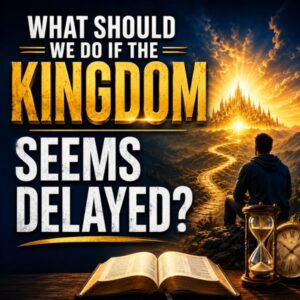 Why Our Obsession with the End Times is Killing the Future
For the full sermon Click Here
Impatience is a universal human tax, but in spiritual circles, it carries a unique, paralyzing weight. We are haunted by the “delay of the Kingdom,” an underlying anxiety that the clock is ticking and we are simply waiting for a finish line that perpetually recedes. We spend our lives squinting at the horizon, searching for signs of the end, while the world around us remains unbuilt.
But we have to ask: Does our obsession with when the rescue happens actually prevent us from making it happen? If we are so focused on leaving, do we lose the will to lead? The early church faced this exact tension, and their story offers a surprising “manual for the meantime”—a directive that shifts our focus from passive observation to active, multi-generational construction.
Stop Looking at the Sky: The Angelic Rebuke
In the first chapter of the Book of Acts, we find the disciples in a state of holy paralysis. They had just spent forty days being tutored by the resurrected Christ on the logistics of the Kingdom. As Jesus ascended into the clouds, the disciples stood fixed to the spot, gazing steadfastly toward heaven.
The response they received was not an encouragement of their wonder, but a sharp, almost blunt rebuke. Two men in white apparel appeared and essentially told them to snap out of it: “Ye men of Galilee, why stand ye gazing up into heaven?” The takeaway is startlingly counter-intuitive: the era of looking up was over; the era of working had begun.
“The angel had to tell these men… ‘All right, that’s over. Quit looking up into heaven. Go do what the Christ told you to do.'”
Today, much of our modern “Gospel” does the exact opposite. It trains believers to be sky-watchers, urging them to focus almost exclusively on the imminence of a return rather than the weight of the work at hand. We have traded the plow for the telescope, and in doing so, we have abandoned the field.
The “Paul Question” vs. The Modern Question
There are two ways to look at the future: the pessimistic and the productive. The pessimistic view asks the “Modern Question”: What is going to happen to me? It is a mindset of fear, focused on whether we will be rescued before the next crisis or the next “communist” arrives.
Contrast this with the reaction of Saul of Tarsus on the road to Damascus. Confronted with a blinding, miraculous vision of Christ, Saul didn’t ask about the timing of the end. He didn’t ask, “Lord, what are you going to do with me?” or “When are you coming back for the rest of us?”
Saul asked the “Paul Question”: “Lord, what wilt thou have me to do?”
This shift is the pivotal “AHA!” moment for any believer. Saul wasn’t converted just to be “saved” or “taken off” the planet; he was converted to be a “chosen vessel” for labor. When we stop asking when we will be rescued and start asking what our assignment is, our productivity explodes. We stop being victims of history and start becoming its authors.
The Destructive Side of “Date-Setting”
History is littered with the wreckage of “date-setting,” and the consequences are never just theological—they are social and economic. In 1831, William Miller famously predicted the return of Christ for April 1843. As the date approached, the results were devastating. Men stopped their businesses, sold their homes, and—as the source records—some even went on a “splurge” with their remaining money because they believed they would no longer need it.
When people believe the end is mere days away, they stop building. They stop investing. This “imminence” culture creates a vacuum of responsibility. Paradoxically, it leads to a “falling away” from the faith. When the predicted date passes and the world keeps spinning, the disappointment turns to cynicism. People fall from their steadfastness because their faith was built on a deadline rather than a mandate.
Building in “Babylon”: The Jeremiah Mandate
The biblical response to living in a captive or “anti-Christ” system—what the scriptures call “Babylon”—is not to wait for a miraculous exit. It is to build a civilization.
In Jeremiah 29, the prophet sent a letter to the exiles in Babylon that contradicted every escapist instinct they had. He didn’t tell them to pack their bags or look for signs of the end of the captivity. He gave them a mandate for multi-generational persistence:
* Build houses and live in them.
* Plant gardens and eat the fruit.
* Marry and have children.
* Crucially, find wives for your sons and husbands for your daughters so that they, too, have children.
The goal was to increase and not diminish. The Kingdom is built through the persistence of the Christian family over decades and centuries.
The danger of ignoring this mandate is dark. Consider the modern man who recently argued in a public forum that abortion was acceptable because “the age is over and the time for raising children is at an end.” This is the depravity of an “imminence-only” theology. When you believe there is no future, you feel no obligation to protect life or build for the next generation.
The “Hidden Sauls” in Unlikely Places
We often make the mistake of assuming we know who is “on our side.” We write off political enemies or “liberals” as beyond the reach of the Kingdom. However, reality is often more ironic.
Take the political landscape of Washington D.C. It has been observed that staff members for “liberal” figures like Hubert Humphrey and George McGovern were often deeply receptive to Kingdom laws and economics, listening intently to how God’s way could benefit the country. Meanwhile, a legislative assistant for a “hardcore conservative” like Senator John Tower dismissed the message entirely, claiming the Senator was already a “Bible student” and had nothing left to learn.
We cannot choose who will hear the word. Just as the disciples would never have chosen Saul—their most violent persecutor—to be their greatest preacher, we must look for the “Sauls” in unlikely places. Our job is not to judge the soil, but to sow the seed.
A Call to Steadfastness
The Kingdom of God is not a red circle on a calendar; it is a civilization to be built through families, homes, and consistent obedience. The “times and seasons” belong to the Father, and they are not our business. Our business is to “occupy” and to build.
If we want to see a turning in our nation, we must stop gazing at the sky and start planting gardens. We must look at our work, our investments, and our families through the lens of a century, not a week.
Ask yourself: If you knew the Kingdom was delayed by another hundred years, how would your work, your family, and your investments change today? The answer to — question is your actual mission. Stop looking up. Get to work.