Why the Global Failure of Christianity is Scripturally Mandated
The 1,900-Year-Old Question
At the close of the Gospel of Matthew, Jesus Christ issued what the modern church comfortably calls the “Great Commission.” Claiming all power in heaven and earth, He commanded His followers to go and make disciples of all nations. Yet, nineteen centuries later, any honest analyst must confront a staggering reality: Christianity is not winning; it is losing ground at an accelerating rate.
In the last century, missionaries reached every corner of the globe; today, vast regions of Asia and Africa have shuttered their borders to the faith, while Western governments systematically excise Christian influence from the public square. Even in the United States—the supposedly most “Christianized” nation on earth—the “belief” of the masses is paper-thin. This leads to a conclusion that modern evangelicals are too terrified to voice: Has the Great Commission failed, or have we fundamentally misunderstood the very objective of the command? The analytical reality suggests that our failure to “convert the world” isn’t a lack of effort, but a failure to read the text.
The Paradox of “Power” and Results
The text demands we acknowledge a fundamental tension. Scripture describes the Word of God as “quick and powerful, and sharper than any two-edged sword” (Hebrews 4:12), a tool for doctrine, reproof, and instruction. If the Word is truly this potent, why is the historical record so fragmented?
Consider the Apostle Paul in Acts 2
8. A master orator and scholar, Paul spent an entire day expounding on the Kingdom of God. Crucially, he did not rely on modern emotional appeals; he persuaded them “out of the law of Moses and out of the prophets” from morning until evening. The result was not a city-wide revival, but a clean, surgical split: “some believed the things which were spoken, and some believed not.” This division is the Word functioning exactly as designed—as a sword that separates. The “exhaustion” of biblical knowledge we see today among nominal Christians is not a new problem, but the inevitable outcome of a message that has been stripped of its covenantal weight:
“We have about one half of the people are nominally Christians. But if you would talk with most of them, I’m sure most of you will agree that within about 5 minutes, you will exhaust their knowledge of the Bible or at least of 95% of them.”
Unbelief as the Historical Norm
The modern “crisis of faith” is a historical myth. Skepticism is not a byproduct of the Enlightenment; it is the default state of the human heart, as evidenced by the timeline of the text.
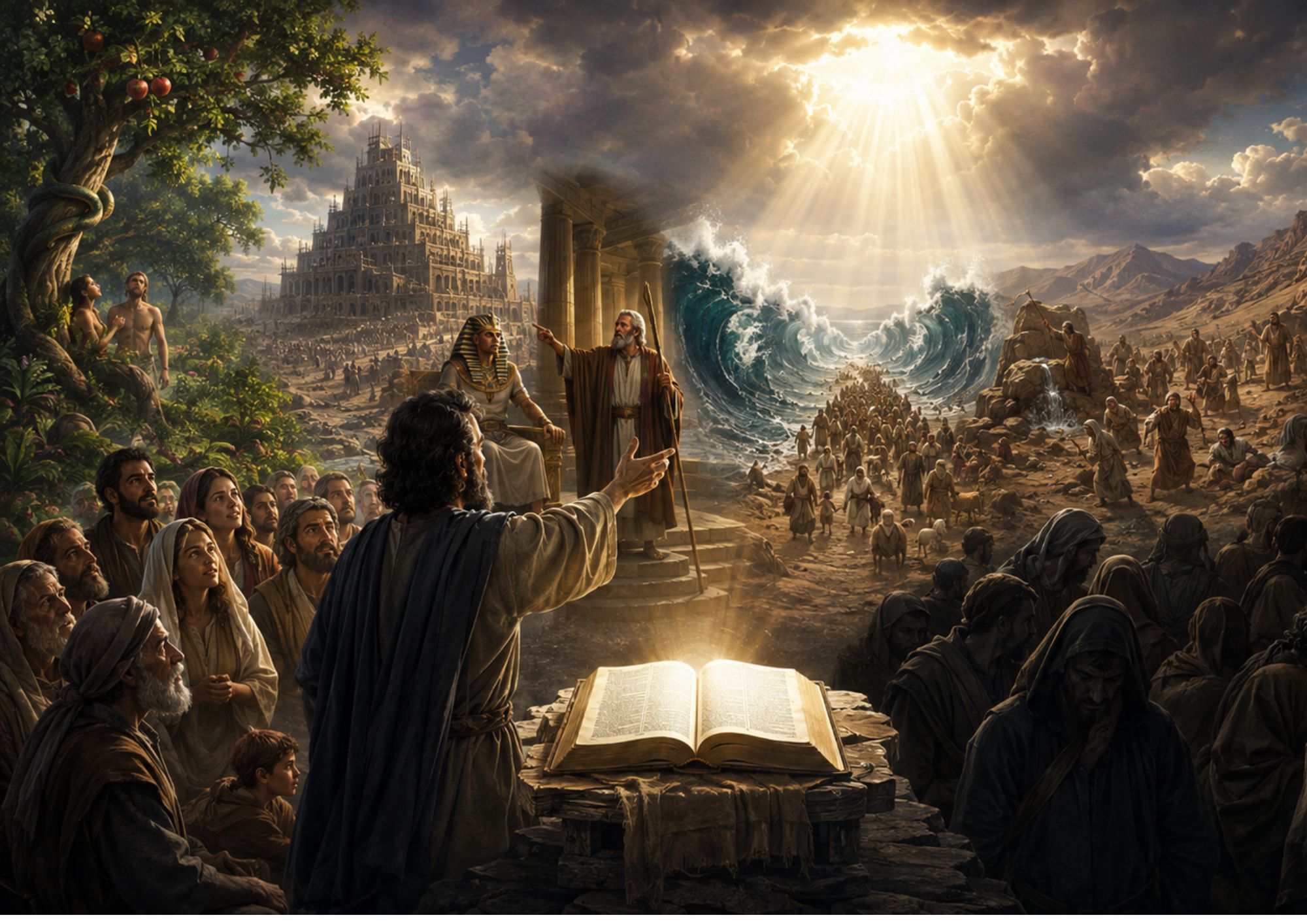
* Eden: Adam and Eve spoke directly with the Creator, yet chose the lie of a stranger over the command of God.
* The Flood: It took only 1,500 years from the dawn of creation for humanity to reach a state where God was forced to liquidate the earth because every imagination of man’s heart was “only evil continually.”
* Babel: Only a few hundred years after the survivors of the Flood stepped off the ark, they had already organized a global rebellion at Babel, necessitating a divine confusion of languages.
The biblical record is a chronicle of God intervening to destroy what disobedient men were building. Unbelief is the rule; it is the covenantal exception that is the anomaly.
The Egyptian Lesson: Belief unto Destruction
The Exodus account provides the most devastating critique of modern “soul-winning” theology. Through a series of national disasters, God systematically broke the pride of Egypt. By the time the plagues concluded, the Egyptian magicians, Pharaoh’s servants, and eventually the entire population “believed” that the God of Israel was supreme.
However, this was a “Belief unto Destruction,” not salvation. God did not send Moses to “convert” Pharaoh; He deliberately hardened Pharaoh’s heart so that He could manifest His power through Egypt’s ruin. The soldiers at the Red Sea realized too late that God was fighting for Israel, but their acknowledgment of His power was met with drowning, not grace.
“There is not one word in this prophecy that God is going to convert the Egyptians and make believers and followers of Jehovah Jesus in all of the pages of Exodus.”
The purpose was the deliverance of the Covenant people and the plundering of their enemies, not the creation of “Egyptian Christians.”
Purpose Over Popularity: The Doctrine of Election
The disparity between the believing remnant and the unbelieving mass is explained in Romans 9 through the context of Isaac and Rebecca. Paul notes that when the twins, Jacob and Esau, were “not yet born,” and had done “no good or evil,” God had already made His choice.
The “Key of Verse 11” is the doctrine of election: “that the purpose of God according to election might stand, not of works, but of him that calleth.” This dictates that God’s plan is not a democratic effort to win a majority. On the contrary, all global events, nations, and historical movements are subservient to God’s purpose and will in Israel. The survival of the Covenant people is the axis upon which history turns; the “popularity” of the message among the nations is an irrelevance.
The Scathingly Polite Falsehood of Modern Evangelism
Modern evangelism has abandoned the “Law and the Prophets” in favor of a “multi-racial Christian” utopia that the Bible never promised. The most glaring example is the legacy of Billy Graham in Kenya. Graham famously praised Kenya under Jomo Kenyatta as a “shining example” and a “paradise on earth.”
The “Cultural Analyst” must look at the grit Graham ignored. Kenyatta was the architect of the Mau Mau, a terrorist organization whose members took blood oaths to kill white men and eat their organs. For Graham to label such a regime a “Christian nation” is the height of the “false prophet” phenomenon. Just as God never intended to make a Christian nation out of Pharaoh’s Egypt—the enemy of Israel—there is no scriptural mandate to “convert” the enemies of the Covenant today. To suggest otherwise is to ignore the specific boundaries God established in the Law.
Conclusion: The Covenant vs. The Crowd
The Great Commission was never a mandate for the universal conversion of the human race. It was a command to gather an elected people according to a divine schedule. If the Word of God is a “discerner” of the thoughts and intents of the heart, its primary function is to divide—to separate the “Jacob” from the “Esau.”
We must stop measuring “success” by the metrics of the crowd. The history of the text shows that belief and unbelief are not matters of intellectual persuasion or the volume of a preacher’s voice; they are matters of sovereign timing.
The question remains: Are you seeking a God who converts the masses, or the God of the Covenant who “remembered” a specific people in their bondage? The true objective of the Great Commission is not to save the world, but to fulfill a specific, ancient promise to a specific people. The sword is still dividing; the only question is which side of the blade you are on.