Our Coming Days of Repentance
Weekly Sermon, 29 March 2026
By Pastor Sheldon Emry
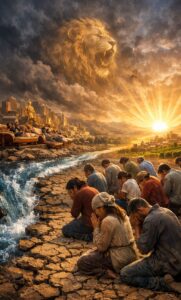
Summary
This briefing synthesizes the central themes and scriptural analyses regarding a perceived national mandate for repentance within the United States, framed through the lens of Kingdom Identity theology. The core argument asserts that the current social, economic, and physical afflictions facing the nation—ranging from drought and pestilence to political instability—are not coincidental but represent divine “chastisement” intended to compel a return to biblical law.
The analysis concludes that national healing is contingent upon more than superficial religiosity. It requires a profound “humbling” of the people, an abandonment of “wicked ways” (specifically defined as violations of biblical statutes such as those governing interest and usury), and the restoration of “judgment in the gate”—the implementation of divine law within civil government. The document outlines a sequence of events: divine judgment creates incurable sorrow, which leads to a desperate seeking of God, ultimately resulting in a new covenant relationship and the material restoration of the land.
The Theology of National Chastisement
The provided texts argue that God uses affliction as a primary tool to facilitate national repentance. This is based on the premise that prosperity often leads to spiritual complacency.
The Mechanism of “Jacob’s Trouble”
The texts identify the current era as the “time of Jacob’s trouble,” a period of unprecedented distress.
The Incurable Wound: Jeremiah 30 is cited to explain that the nation’s “sorrow is incurable” through human effort because of the “multitude of iniquity.”
The Rod of the Enemy: World communism, specifically Russia and China, is characterized as the “rod in God’s hand,” raised to chastise the nation until it turns back to the Word of God.
The Severity of Distress: The “fear and trembling” of this period is likened to the travail of a man experiencing birth pangs, signifying a level of distress that overwhelms traditional masculine strength.
Indicators of Divine Judgment (2 Chronicles 7:13)
Before the promise of healing in 2 Chronicles 7:14 can be realized, the conditions of verse 13 must be recognized as active:
Drought: Severe weather patterns and crop losses (such as those in West Texas) are viewed as the “shutting up of heaven.”
Pestilence: The text identifies modern diseases—cancer, heart disease, and strokes—as the “pestilence among my people.” It specifically links these to behaviors like smoking and the “epidemic proportions” of venereal disease among the youth.
The Locusts: Interpreted not as insects, but as a “great army” sent to devour the wealth of the people. This is explicitly linked to high taxes and interest rates that “rob and plunder” the fruit of labor.
Critique of Contemporary Religious Institutions
The analysis offers a sharp critique of modern American Christendom, characterizing it as largely superficial and complicit in national sin.
The Rejection of Doctrine
The texts assert that large churches and famous evangelists often avoid “Bible doctrine” because it is offensive to the masses.
“Smooth Things”: Ministers are accused of preaching comfort and “nice things” to maintain large congregations and financial income.
The “Bishop” Model: A humorous but scathing reference is made to a priest’s advice on how to build a wealthy ministry by avoiding doctrinal depth and focusing on image.
The Famine of the Word: Despite the abundance of churches, the text claims there is a “famine of hearing the Word of the Lord,” where people go from city to city seeking truth but find only “false, unscriptural doctrines.”
The Sin of Usury (Interest)
A primary point of contention is the economic system adopted by both the nation and its churches.
Unscriptural Money System: The charging of interest is labeled an “abomination” that violates God’s law and carries the death penalty under Ezekiel’s statutes.
Church Complicity: The text condemns churches that use borrowed money at interest to build sanctuaries, calling this a form of bondage for the poor and the widow.
Worship of “Moolak”: Participation in these systems and the adherence to false doctrines is equated to the ancient Israelite worship of Moloch and Chiun while simultaneously offering sacrifices to God.
The Path to Restoration
Restoration is presented as a multi-step process involving personal transformation and systemic legal reform.
Requirements for Healing (2 Chronicles 7:14)
The text emphasizes that God will not heal the land until His people—identified as those “called by My name”—fulfill four conditions:
1. Humble Themselves: Recognizing their inability to solve national problems through politics or industry.
2. Pray: Seeking divine intervention over human solutions.
3. Seek My Face: A deep, prioritized pursuit of God’s presence and will.
4. Turn from Wicked Ways: Specifically, a return to the “statutes and judgments” of the Law of Moses.
“Judgment in the Gate”
A central theme is the necessity of reforming the civil government (the “gate”).
Legal Reform: Establishing “judgment and mercy and justice in the land” is prioritized over religious songs and ceremonies.
Hating Evil: The text calls for a literal hatred of evil and a love for good to be reflected in government policy.
Statutes and Judgments: The final appeal of the Old Testament (Malachi 4) to “Remember ye the law of Moses” is cited as the key to the day of repentance.
Key Scriptural Themes and Interpretations
Scripture Key Concept Interpretation in Context
2 Chronicles 7:13-14 The Cycle of Repentance Judgment (drought/pestilence) precedes and necessitates repentance for national healing.
Jeremiah 30:7-22 Jacob’s Trouble A time of maximum distress where God breaks the yoke of the stranger and restores “David their king.”
Amos 5:21-24 Rejection of Ritual God “hates and despises” religious feasts if they are not accompanied by “judgment running down as waters.”
Hosea 6:1-2 The Third Day A prophecy that after “two days” (2,000 years of the Christian age), God will “revive us” and we shall live in His sight.
Ezekiel 36:25-37 The New Covenant God will provide a “new heart” and “clean water,” leading to the land becoming like the “Garden of Eden.”
Amos 9:13-15 Material Restoration The promise that the “plowman shall overtake the reaper,” signifying supernatural abundance and permanent residency in the land.
Conclusion
This sermon presents a vision of the United States as a nation under active divine judgment. The “Day of Repentance” is not merely a liturgical event but a necessary turning point to avoid total desolation. The document suggests that while the “affliction of Joseph” is currently ignored by the majority, the worsening of “Jacob’s trouble” will eventually force a remnant to seek God “early.” The ultimate goal is the restitution of the Kingdom, defined by the implementation of biblical law and the subsequent material and spiritual healing of the land.