How Private Equity Uses Mobile Home Parks to Get Rich & Create Homelessness
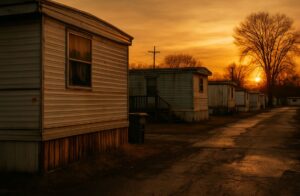
They keep telling you homelessness just happens. They blame drugs. They blame mental health. They blame laziness. They blame bad choices.
But let me tell you the truth—the one that terrifies them.
Homelessness is not an accident. It is an outcome. And private equity is engineering that outcome for profit.
If you think I’m exaggerating, stay right here—because what I’m about to explain is horrifying.
There is an entire business model built on pushing seniors, low-income families, and fixed-income Americans out of the last affordable housing left—mobile home parks—and into homelessness. Not because these people failed, but because someone decided they were profitable to remove.
Mobile home parks used to be the one place an average person could breathe. You didn’t need a massive mortgage. You didn’t need perfect credit. You didn’t need six months of rent saved up. You just needed a small home, a patch of land to sit it on, and a community of people trying to hold on.
Then private equity discovered something horrifyingly convenient.
Mobile homeowners may own the home, but they don’t own the land. And when you don’t own the land, you’re trapped.
You can’t just pick up and move. You can’t hook a truck to your single-wide and haul it across the state. Moving a mobile home can cost anywhere from $8,000 to $20,000, and that’s if the home can survive the move. Most can’t.
So when Wall Street buys your park and raises the lot rent, you pay—or you lose everything.
This isn’t a housing market. This is hostage-taking.
When a private equity firm buys a mobile home park, they’re not investing in affordable housing. They’re investing in people who can’t leave.
First, they buy the park quietly, often through a shell LLC, so residents don’t know who owns them.
Next, they raise lot rent immediately. Fifty dollars here. One hundred dollars there. Then two hundred more a few years later. They call it “bringing rent to market rates,” market rates they themselves inflated.
Then they add fees—administrative fees, trash fees, sewer fees, cable fees, driveway fees, and so-called community improvement fees—without improving anything.
After that, they stop maintaining the park. Roads crumble. Sewer lines fail. Water systems degrade. The goal isn’t service. It’s desperation.
Desperate tenants sell their homes cheaply. The park owner buys them.
Then come the violations. A skirt one inch off. A shed the wrong color. A porch too large. A window needing replacement. Violations turn into fines. Fines turn into eviction threats.
Eviction in a mobile home park isn’t just losing a home. It’s losing everything.
If residents can’t afford to move their home, it’s seized. If they leave it behind, it’s taken. If they lose a job, it’s taken. The home is then resold.
Finally, the property is flipped and rents are raised again.
This is how equity is extracted from the poor to enrich people who will never live in these communities.
Homelessness isn’t exploding because of moral failure. It’s exploding because of manufactured displacement.
Wall Street targeted mobile home parks because residents are low-income and fixed incomes provide predictable cash flow. Many residents are seniors.
Seniors don’t fight back. Seniors don’t move. Seniors don’t protest. Seniors don’t go viral.
The land is cheap. The income is reliable. Tenants can’t leave.
Mobile homeowners are renters. They are the only people who must abandon their home to escape rising rent.
If an apartment becomes too expensive, a tenant can leave. If mobile home lot rent rises, the homeowner is trapped.
Private equity understands this and has built a business around it.
This isn’t theoretical. These are real people—seniors, veterans, widows, people on disability—living on $1,000 to $1,200 a month.
When lot rent rises from $350 to $500 to $750 in just a few years, their budgets collapse.
They have no savings. No safety nets. Often no family.
They end up in RVs, vans, motel rooms, relatives’ driveways, or tents under bridges.
No one chooses to lose their home at seventy years old. No one chooses to shower at truck stops or sleep in parking lots.
They are pushed, step by step, until no choices remain.
This is not an accident. It is a pipeline from mobile home to eviction to the street.
Politicians could stop this, but they don’t. Private equity funds campaigns, hides behind LLCs, and faces little federal regulation. Cities want redevelopment. Seniors quietly disappear.
Homelessness becomes an acceptable side effect of profit.
Private equity removes people slowly, one lot at a time, so the pattern stays hidden.
But the pattern is real, and people are seeing it.
This isn’t random. This is intentional.
They didn’t destroy the American dream. They bought it, stripped it, raised the rent, added the fees, took the equity, and blamed the victims.
You’re not the failure. You’re the target.
And now that you see the playbook, they can.